
Why Dogs Bark
The Voice Dogs Use to Communicate
Imagine sitting quietly in your home when suddenly your dog begins barking at the window.
Perhaps someone is walking past the house.
Maybe another dog is outside.
Or maybe there is nothing obvious at all.
For many dog owners, barking can feel confusing — and sometimes frustrating.
But barking is not random noise.
For dogs, barking is simply another way of communicating.
It is their voice.
And just like people use tone, volume, and words to express different feelings, dogs use barking in many different ways depending on what they are experiencing.
Understanding why dogs bark begins with recognising that barking is part of a much bigger communication system.




Barking Is a Natural Behaviour
Dogs did not learn to bark from us.
Barking is a natural behaviour that has existed throughout their history as a species.
Wild canids such as wolves, foxes, and coyotes also vocalise, although domestic dogs tend to bark more frequently.
Over thousands of years living alongside humans, dogs have learned that barking can be an effective way to communicate with us.
A bark might mean:
- “Something is approaching.”
- “I’m excited.”
- “I’m worried.”
- “I want your attention.”
The meaning depends entirely on the situation.
This is why barking should not be viewed simply as a behaviour to stop, but as a signal to understand.
Different Reasons Dogs Bark
Dogs bark for many different reasons, and the context usually reveals the purpose.
Alert Barking
This is one of the most common types of barking.
A dog may bark when they notice something new in their environment — a person passing the house, a knock at the door, or an unfamiliar sound.
In this situation, barking often serves as a warning or announcement.
The dog is essentially saying:
“Something is happening here.”


Excitement Barking
Dogs may also bark when they feel excited.
This often happens during play, when greeting their owner, or when anticipating something enjoyable such as a walk.
Excitement barking is usually accompanied by other signals such as:
- loose body movements
- wagging tail
- jumping or bouncing behaviour
In these moments, barking is simply part of expressing enthusiasm.
Attention-Seeking Barking
Sometimes dogs learn that barking gets a response.
If barking leads to attention, play, or food, the behaviour may continue because it works.
In these cases the dog may be communicating:
“I would like your attention.”
This type of barking often happens when a dog feels bored, frustrated, or simply wants interaction.


Frustration Barking
Dogs may bark when they cannot reach something they want.
For example:
- seeing another dog but being unable to approach
- being confined behind a gate or fence
- wanting to join people or activity
Frustration barking can sound more intense and may be combined with pacing or pulling.
Fear or Uncertainty
Sometimes barking comes from uncertainty.
If a dog feels uncomfortable or unsure about something in their environment, barking can create distance.
In these moments, the bark may be saying:
“I’m not sure about this.”
Body language often reveals this emotional state — stiff posture, ears back, or cautious movement.



Listening to the Whole Picture
Barking on its own rarely tells the full story.
To truly understand what a dog is communicating, it helps to look at:
- their body language
- the environment
- the situation they are in
For example, a bark while wagging and bouncing during play carries a very different meaning from a bark paired with a tense body and fixed stare.
This is why behaviour is best understood as a combination of signals rather than a single action.
Why Understanding Barking Matters
When we begin to understand barking as communication, it changes the way we respond.
Instead of simply trying to stop the noise, we can ask a more useful question:
“What is my dog trying to tell me?”
Sometimes the dog may need reassurance.
Sometimes they may need more stimulation, exercise, or mental engagement.
And sometimes they may simply be reacting to something unfamiliar.
Recognising the message behind the bark helps owners respond in ways that support their dog’s emotional wellbeing.


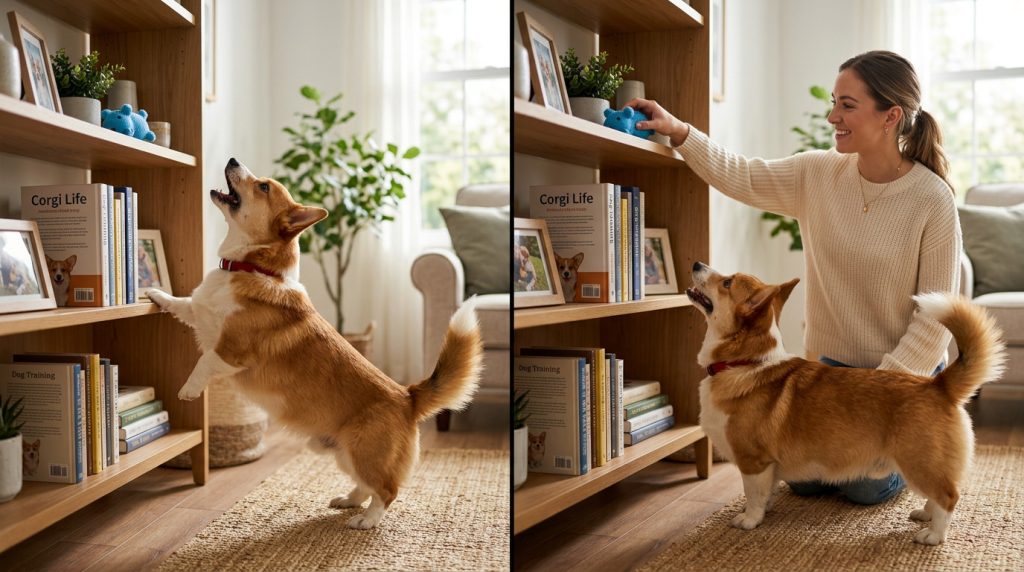
Learning to Hear What Your Dog Is Saying
Every dog communicates a little differently.
Over time, as owners become familiar with their dog’s body language, routines, and environment, barking becomes easier to interpret.
The goal is not to eliminate barking completely.
It is to understand the situations in which it happens and what your dog may be expressing.
And when we start to recognise these signals, communication between dog and owner becomes much clearer.
Explore More Dog Behaviour Topics
Understanding dog behaviour is an ongoing process. Each behaviour we see — whether it’s barking, jumping, following us around the house, or tilting their head — is part of how dogs communicate and experience the world.
These guides explore some of the most common behaviours owners notice and help explain what dogs may be thinking, feeling, or responding to in everyday situations.
What to Explore Next
Barking is one way dogs communicate, but it often makes more sense when we understand what they are feeling and responding to.
These guides can help you better interpret your dog’s behaviour, recognise emotional signals, and understand what may be driving different types of barking.



Continue Learning
Barking is just one piece of the communication puzzle.
Dogs use a wide range of behaviours to express how they feel and what they need.
In our course Understand Your Dog – Dog Psychology for Beginners, we explore how dogs communicate, why common behaviours happen, and how owners can better interpret what their dog may be experiencing.
By learning to see behaviour through your dog’s perspective, everyday interactions become easier to understand — and the bond between you and your dog becomes stronger.